

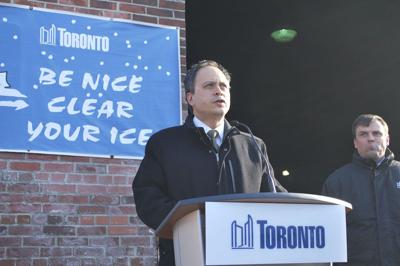
The City of Toronto is promising to be ready to salt and clear main roads and expressways following major snowfalls this winter.
Six hundred road plows, 200 salt trucks and 300 sidewalk plows are currently at the city’s disposal to deal with winter conditions, said public works chair Denzil Minnan-Wong on Thursday, Nov. 20.
Also planned for 2014 and 2015 is a special pilot project for improving bike paths.
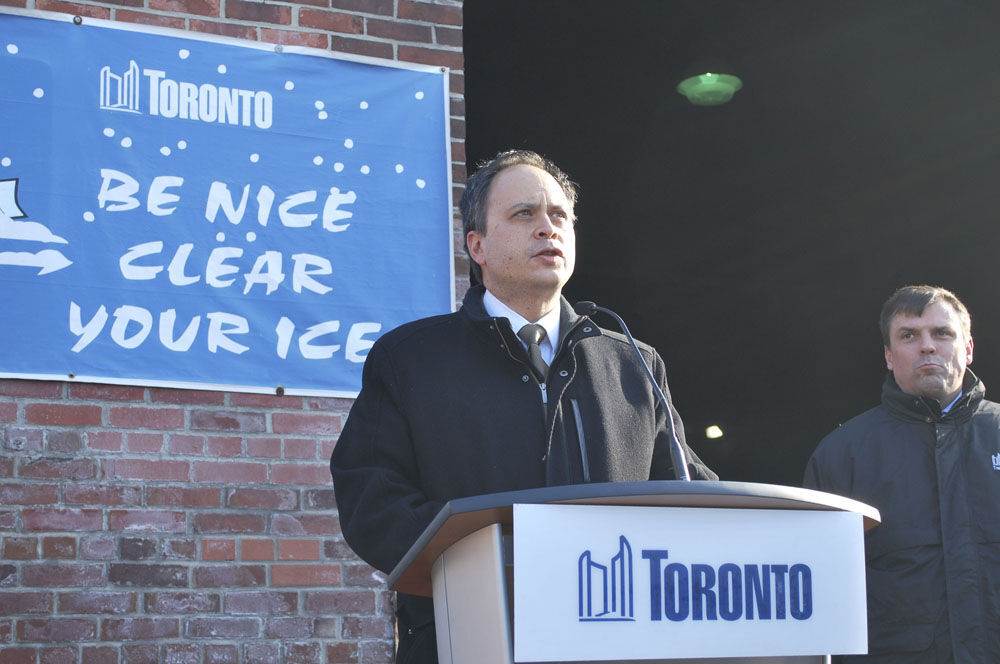
"We’re prepared again this winter for whatever happens," said Minnan-Wong during a press conference held the day after the city experienced its first major snowfall of the season, which led to traffic tie-ups and delays during rush hour.
Briefing the media from the city’s maintenance facility at 433 Eastern Ave., Minnan-Wong said the priority for snow clearance puts the plowing of main roads and expressways at the top, followed by arterial roads and then – when there’s five centimetres of snow on the ground – residential streets.
"We want to remind residents it takes time to clear all the local streets," he said. "It takes between 14 and 16 hours to clear all the roads in the city."
In cases of major winter events, such as last year’s ice storm, the city’s transportation services department also has the ability to declare a "major snow storm condition" which would allow for emergency plowing if required. As well, parking would be prohibited on any routes designated with the condition.
Minnan-Wong said the city would also attempt to clear sidewalks, but in some areas like in the central parts of the city where plows can’t go, it would be up to residents to have the paths cleared within 12 hours of a snowfall.


He also asked residents not to shovel snow onto the street, and for drivers not to park and block streetcar service, as was the case at times last winter.
"Not only is it impolite, we’ll tow you," he said.
He also urged residents spotting watermain leaks to report them to the city by calling 311.
While the city replaces around 40 to 60 kilometres of aging watermains per year, and performs rehabilitation work on 200 more kilometres, leaks and breaks are still prevalent particularly from older models dating back to the ’50s and ’60s, said a spokesperson for the city’s water department.
New this year for the city’s winter plans is a pilot project for improving traction on bike paths.
City road operations manager Robert Burlie, who came up with the concept, said the plan involves having snow plows attached with wheeled trailers whose tire weight will create the necessary friction to properly brine salted and plowed road surfaces to make it less slick.
"There will be a wheeled trailer behind the machine that will mimic normal tire action, and it should open up the bike lanes and improve traction over time," Burlie said.
Burlie said the pilot bike lane clearance would only take place along the Martin Goodman Trail for now but could be expanded to all separated bike lanes if it proves a success.
"Our test will be, do we meet the arterial road level of service for a bike lane which is creating bare pavement conditions within two to four hours after plowing and salting," he said. "That’s our threshold of success."











Anyone can read Conversations, but to contribute, you should be a registered Torstar account holder. If you do not yet have a Torstar account, you can create one now (it is free).
To join the conversation set a first and last name in your user profile.
Sign in or register for free to join the Conversation