


While its uses may have changed over the years, the venerable Don River still continues to play an important role in the lives of Torontonians.
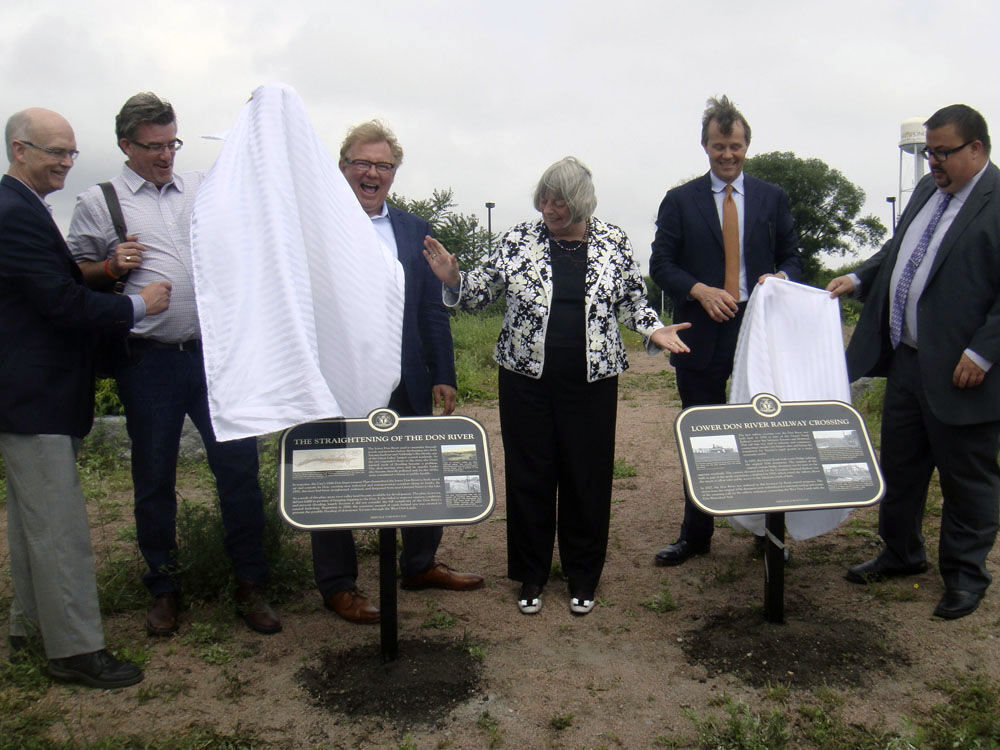
Heritage Toronto in partnership with Toronto and Region Conservation Authority and Waterfront Toronto recently honoured the downtown east river’s cultural as well as historical significance by unveiling two heritage plaques; one of which recognizes the straightening of the lower Don River between 1886 and 1892, and the other which commemorates the historic lower Don River railway crossing.
"It’s quite a remarkable story here," said Ward 28 Councillor Pam McConnell during the plaque unveiling event, which was held Wednesday, June 25 on the western bank of the Don River, just north of the railway bridge, at the Bala Underpass.
McConnell said the plaques are just one more reason for people to come to the area and learn more about the fascinating story of the lower Don River.
The original eastern abutment of the first railway crossing over the Don River, which was constructed more than 158 years ago, can still be seen today.
Built as part of the Grand Trunk Railway’s main line between Toronto and Montreal, the bridge was vital to industry and commerce as it connected Canada’s two largest cities and helped lay the foundation for Toronto’s emergence as a major economic centre.
A new bridge was built in 1892 using the original abutments from 1856, while the current elevated track for the Canadian National Railway was completed in 1930. This project raised the railway above the streets to allow for safer public access to the lakefront.
The elevated railway bridge was widened in 2007 to accommodate floodwaters, which would have gone westward through the West Don Lands.


The stones from the original 1856 abutment have been reused as informal seating and as part of the retaining wall for the Bala Underpass, which connects the West Don Lands with the Don Watershed Trail.
Flooding became (and still is) a major concern and public hazard as Toronto began to expand closer to the Don River.
In an effort to address this pressing issue, the lower Don River was straightened, widened and deepened starting at Gerrard Street East down to Lake Ontario in 1892.
The lower Don once meandered through woods and marshes before discharging into both the Toronto Harbour and the Ashbridges Bay Marsh.
By the 1870s, it had become so polluted it was considered a threat to public health.
As a result, the City undertook the Don Improvement Plan to both speed up and contain the flow of the low Don River in 1886. This plan also led to the creation of new industrial and transportation corridors along the river’s banks.
This project freed up land for development but did not fulfill its promise of bringing shipping to the Don. It also failed to improve sanitary conditions and prevent flooding.
To further address ongoing flooding problems, the Don River was widened at the location of the lower Don River railway crossing in 2007.
A massive mound of earth most of which makes up a new park called Corktown Commons was also created in 2006 to further mitigate possible flooding of downtown Toronto through the West Don Lands. The western side of the park opened to the public last summer.
Mark Wilson, Waterfront Toronto’s chair, is a founding member of The Task Force to Bring Back the Don, a 20-member citizen advisory committee that advised City Council on issues concerning the Don River and its watershed.
"The Don River and its heritage is very deep and dear to me," he shared.
"We’re here today to recognize that history and our very complicated relationship with this river."
Wilson also spoke about the present restoration project being done at the mouth of the Don River.
"I really believe this will be a significant project to the world," he said.
"We celebrate the past as we build our sustainable future."











Anyone can read Conversations, but to contribute, you should be a registered Torstar account holder. If you do not yet have a Torstar account, you can create one now (it is free).
To join the conversation set a first and last name in your user profile.
Sign in or register for free to join the Conversation