

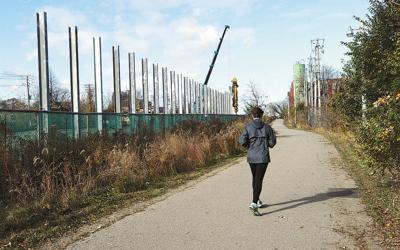
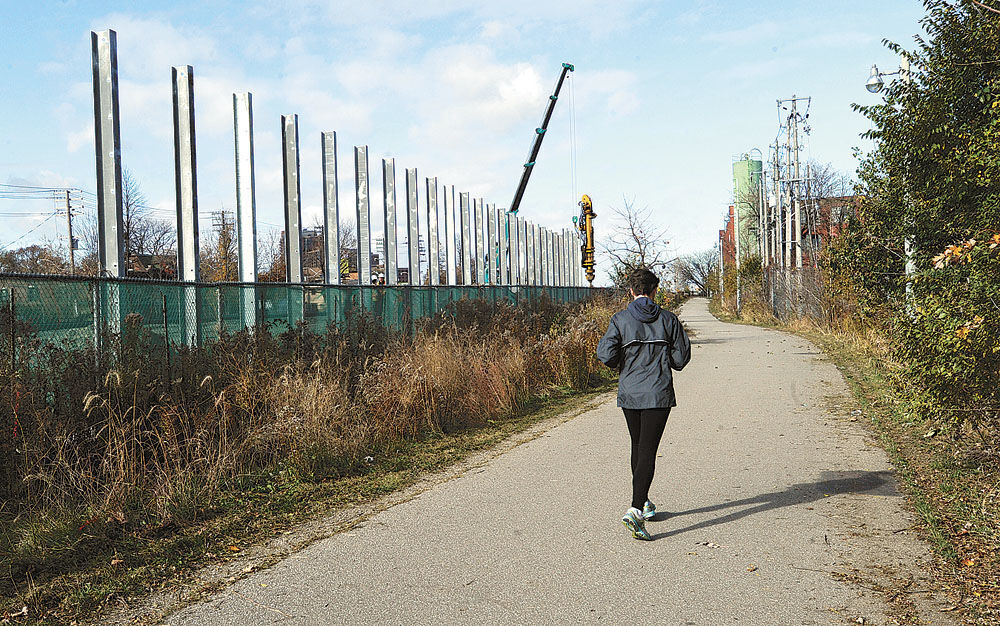
To the chagrin of some, Metrolinx has commenced noise wall construction along the West Toronto Railpath.
The five-metre-tall structures are intended to reduce noise and vibration caused by the projected increase in diesel trains serving the upcoming Union Pearson (UP) Express air rail link. Metrolinx over the past few years has continued to plan for the project, which will involve erecting the walls in segments over 20 kilometres of the Georgetown South rail corridor, shrugging off sustained opposition to the work from local residents’ groups.
Last week, construction crews were spotted along the Railpath putting up large steel pillars to hold the wall segments in place. The pieces themselves, which were chosen through a community consultation process completed last year, will vary from transparent acrylic to precast concrete with a ribbon design.
Some segments of the noise walls will also have specially designed art installations which Metrolinx has pledged to maintain for at least a few years. The first of 14 planned public art installations was unveiled in late September.
Other panels will allow for hanging plants, but a 2013 alternative design proposal introduced by the noise wall-opposing Junction Triangle Rail Committee for a "green wall" made up entirely of natural vegetation was rejected by Metroinx leadership due to maintenance and cost concerns.
Metrolinx also faced criticism for the need to remove trees along the corridor, which it said was unavoidable, although the transit planning agency pledged to plant some 500 replacements, three for every tree removed.
The entire noise walls project is expected to cost $20 million to complete and is part of a series of infrastructure upgrades taking place along the Georgetown South rail corridor in advance of UP.
Critics of the project worry the walls will be used as justification to postpone electrification of UP Express, which Metrolinx says will take place prior to similar conversions on the entire GO rail network within a decade.


Metrolinx claims it has broad support from Georgetown South residents, who will experience five additional decibels of noise because of the uptick in train traffic following UP’s debut. A survey taken in late 2013 of residents living adjacent to the rail corridor found a majority of the respondents supported the noise walls. Critics countered the high approval rate is because only 22 per cent of those contacted responded to the survey.
The noise walls are scheduled for completion in early 2015, before UP begins service in time for the Toronto Pan Am/Parapan Am Games.











Anyone can read Conversations, but to contribute, you should be a registered Torstar account holder. If you do not yet have a Torstar account, you can create one now (it is free).
To join the conversation set a first and last name in your user profile.
Sign in or register for free to join the Conversation