


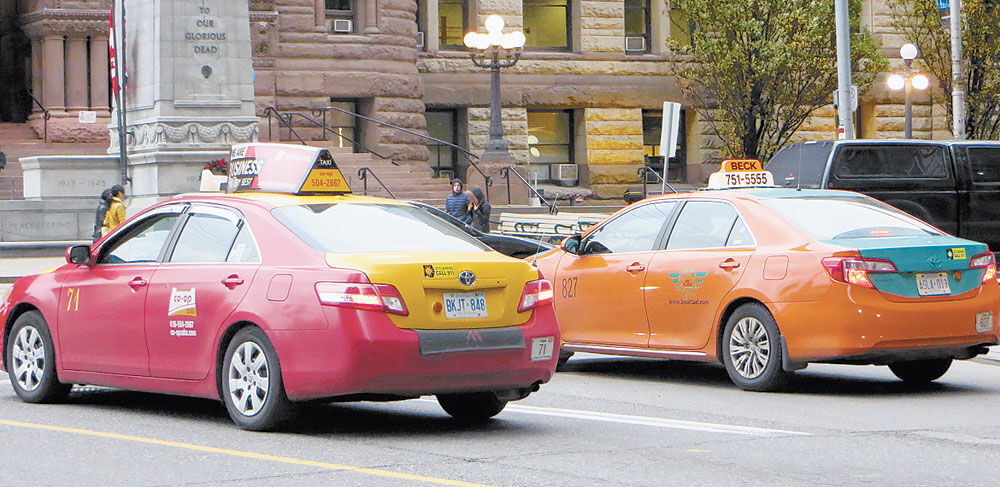
Toronto taxicab companies will be in court next week trying to quash the city’s plans for its taxi industry, arguing councillors didn’t approve changes properly at a February meeting.
But whether or not the challenge by the Toronto Taxi Alliance on Nov. 17 succeeds, taxicab companies and brokers are preparing to ask members of the new city council to study taxi reform again.
"When they take a good look, we will get a better result," Gail Souter, a TTA director and the owner of Beck Taxi, predicted.
Souter maintains many councillors "weren’t aware of what was being decided on" when they approved amendments to the final report on the Toronto Taxi Industry Review, which was three years in the making. Councillors need to take another look, she said, and "follow their own procedural rules."
The TTA has an ally in Cesar Palacio, a Davenport councillor who, as chairperson of the city’s Licensing and Standards Committee during the last term, oversaw the debate on taxi reform and last week said a further review "is needed immediately."
It’s essential to get consent from all industry stakeholders for the city’s plan, "and not just to impose it on them," but changes made on the floor of council meant that couldn’t happen, he said.
"It’s critical that we hear from everyone – and they didn’t get a chance to be heard," said Palacio, arguing if the review was voted on now, many councillors who voted for amendments – enacting 10 recommendations Palacio’s committee wanted to defer for a year - wouldn’t support them.
A frequent complaint from the TTA side of the debate is the "devastation" the city’s amended plan has done to the value of Toronto’s 3,400 Standard taxi plates, which can be sold and are still the city’s most common cab license.


Though Souter described the Standard as a well-deserved "plum" cab drivers have earned through a lifetime of labour, critics argue many are in the hands of brokerages or other people who never drove a cab.
Souter charged municipal authorities "have tried to destroy the value of the Standard plate" through 15 years of taxi-industry reforms attempting to create an "owner-operated" system, and that – though none have sold – the price of a plate since February dropped from $350,000 to $100,000.
"There are a lot of fretful owners," she said.
Since 1998, the city has created Ambassador taxi licences which could only be driven by their owners, but these owners couldn’t sell and got nothing if they died or retired.
The reforms passed in February say the 1,400 Ambassador owners can have two drivers, and can sell.
Standard and Ambassador licenses that are sold, however, will be reclassified as a Toronto Taxicab License, or TTL, and these licenses must be for cabs that are accessible to customers with disabilities.
According to the city’s plan, all taxi licenses have to be TTLs by 2024, and instead of starting in 2019 to convert a Standard plate to TTL whenever one is sold, councillors opted to start in July.
"They just changed everything on the floor, which just seems so ludicrous," said Souter, adding buying an accessible cab is a huge burden for license-holders.
"Those reforms have not improved the cab drivers’ situation one iota."
Denzil Minnan-Wong, a North York councillor who supported the amended package, said the TTA’s position is wrong and, should the group manage to win on a technicality, council would pass the same package again.
"If we went back for public hearings on every single thing amended at council, we’d never get anything done at this place," Minnan-Wong said, arguing taxi plate owners "don’t own the license. It’s not recognized in law as property."
If you speculate on the value of something, it doesn’t always go up, he added.
"The city’s obligation is to the customer, and to make sure the service improves," not to preserve the value of the plate, Minnan-Wong said.
Though Palacio said the taxi industry is complicated, and councillors didn’t understand the issues they were voting on, Janet Davis said she’s "absolutely" certain she did.
Before she moved a motion to complete the transition from Standard to TTL plates in 10 years, there was no specified period, she said.
The East York councillor added positions taken by each side in the taxicab review were well known. Even with more consultations, she said, "we would’ve had the same outcome, I believe."
The TTA represent powerful interests, Davis said. "They will continue to exert pressure to maintain the status quo."
The Taxi Workers Association of Ontario, or iTaxiworkers, representing Ambassador plate owners, will also respond to the TTA’s case.
In a submission to Ontario Superior Court, iTaxiworkers says deferring the creation of the TTL licenses for a year "would have delayed and possibly derailed conversion," as well as giving the TTA another chance to convince council and city staff to keep the Standard plate.
"There is no substance whatsoever to the allegation that council acted in bad faith" in passing the amendments, which were done properly, the group argues.












Anyone can read Conversations, but to contribute, you should be a registered Torstar account holder. If you do not yet have a Torstar account, you can create one now (it is free).
To join the conversation set a first and last name in your user profile.
Sign in or register for free to join the Conversation