


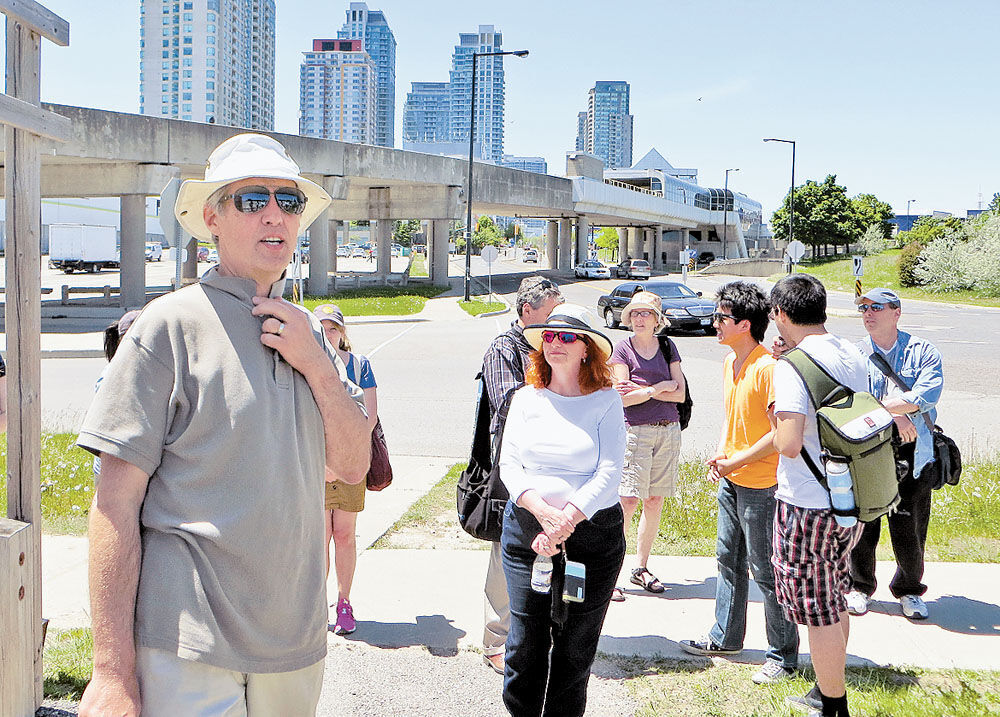
Somewhere between McCowan Station and the park south of Sheppard Avenue, the loneliness of David Soknacki’s position in Scarborough became apparent.
A mayoral candidate and former Scarborough councillor, Soknacki led a walk Saturday to illustrate how light rail, extended north and east from Kennedy Station, will do a better job of serving residents than a subway extension.
But on his two-hour hike Soknacki’s pitch for light rail - that it comes with no tax increase, is ready to be built and has seven stops instead of the proposed subway’s three - lacked local champions to back him up.
Yes, Soknacki’s rival Olivia Chow also favours the LRT option, as do many transit advocates and councillors downtown, but last summer Toronto council voted for a subway, and in Scarborough, there are few people - apart from Scarborough East Councillor Paul Ainslie, Soknacki’s supporter and friend - speaking out forcefully for a switch back to light rail.
Local Liberal and Progressive Conservative candidates jumped at the chance last year to back a subway during a Scarborough-Guildwood byelection, and their parties are just as strongly behind it now.
The New Democrats, after waffling between the options last year, have joined them in supporting the subway.
"We feel Scarborough councillors have spoken clearly on this issue," said Neethan Shan, NDP candidate in Scarborough-Rouge River and also the provincial party’s president.
Though an LRT line would reach more people in Scarborough, most prefer a subway so they can connect to downtown without having to transfer at Kennedy, Shan said on Monday. "That’s what I’m hearing from (residents at) the doors."


Soknacki continued during the walk to argue the LRT is still a better choice, though politics "got in the way" and, he conceded, many of his friends in Scarborough "believe a subway is the best and only way to get around."
Speaking on the walk was Al Witzig, a transportation planner who did the environmental assessment for the planned Finch West LRT, and said the Scarborough LRT will be completely separated from traffic and give people "a ride closer to where they live" than a subway could.
In action, he added, LRT service is regular, even ordinary. It doesn’t arrive late, like buses can, Witzig said.
As the group of about 20 people passed, churches, factories and smaller businesses on Progress Avenue, Rashi Maharaj, an electrical engineer who helped organize the walk, stopped to say Torontonians can compare proposals and see which areas are served or not served.
Unlike the aging Scarborough Rapid Transit line it would replace, there’s no reason to believe the LRT would be less reliable than above-ground portions of Toronto’s subway, he said.
The subway proposal, costing at least $1 billion more, would cut out transit stops near the Dorset Park neighbourhood and at the Progress campus of Centennial College, containing 9,000 students and 1,000 staff.
Mark Toljagic, Centennial’s communications officer, appeared at the walk to say a stop on the campus would be well-used, and the consensus within the college is the LRT would be built faster and a stop would be good marketing, should it take Centennial’s name.
McCowan Road and Sheppard, where the subway would finish, is two kilometres away, too far for Centennial students, he said.
Still, Toljagic added the college considers any transit investment good for Centennial. The college - faced with a policy reversal removing its promised rapid-transit line - "didn’t take out ads," he acknowledged, and no one brought the matter up when Liberal Leader Kathleen Wynne visited the campus last week.
Later, Soknacki said he went to Centennial expecting to hear outrage. "Leaders of the Centennial Student Association said they supported LRT, but they will graduate in four years and not see it," he recalled with a shrug.
"I don’t know if they’ve become resigned over accepting second-best transit, but they don’t need to be," said the candidate, who ended his journey in a green space on Progress Avenue just south of the Chinese Cultural Centre of Greater Toronto, promising not to let his position on the LRT drop.
"We have announced it from the beginning of the campaign, and we are continuing to raise the issue."
On Tuesday, Bryan Heal, a member of Dorset Park Neighbourhood Association, said the group, which has no executive, is unlikely to endorse one option over the other.
The polarizing nature of the LRT-subway argument has turned many people off, Heal said. "There’s not a lot of faith that something will get built and that a plan will get stuck to."
Surveys of residents have found jobs, community safety and access to services were more pressing issues in the neighbourhood, where most transit users are bus riders.
"There’s not enough conversation about how to make bus service better and more reliable," said Heal.
In a statement Tuesday, management of the cultural centre said they would not oppose either rapid-transit option, as both would take people to their doorstep. "If funding is not an issue, (the) subway is a better solution as its operation is not weather dependent," the statement said.
Brenda Thompson, a representative for Scarborough Transit Action, was on the walk as an observer. The group is asking municipal candidates running this year how they will address the "transit shortfall" the subway decision creates in Dorset Park and Centennial.
That there are no stations on the proposed subway extension before Lawrence Avenue East and McCowan means people using three Eglinton Avenue East bus routes will lack access to the subway and rapid transit, the group’s survey says.









Anyone can read Conversations, but to contribute, you should be a registered Torstar account holder. If you do not yet have a Torstar account, you can create one now (it is free).
To join the conversation set a first and last name in your user profile.
Sign in or register for free to join the Conversation